Showing posts with label Chinese PLAN. Show all posts

Saturday, January 26, 2013

PLA Naval H-6 bombers conduct bombing drill

A PLA Navy bomber squadron stationed along China’s southeast coastal region recently conducted a live-fire bombing exercise targeting an imaginary enemy port.


At 8:20 A.M., a green flare marked the start of the drill, and a dozen H-6 bombers took to the sky.

“Now starts radio silence! Keep your course by compass and meters!” said the drill commander.

On the mark, the lead bomber makes a drastic descent towards the sea surface, followed by his wingmen. The bomber pilots approach the combat zone at an extremely low attitude, an effective way to avoid radar detection.

At 9:45 A.M., as the bombers close in on the combat zone, they pull up to an attitude of 600 meters and spot the target in distance.

“Target in sight! Target locked!” reports each pilot. Soon after, bomb bay doors open and explosives hit the target area, splashing the water below.

Tuesday, July 24, 2012

New Individual Support System for PLA Soldiers Debuts

According to a briefing, the new individual comprehensive support system developed by the Quartermaster and Equipment Research Institute under the General Logistics Department (GLD) of the Chinese People's Liberation Army (PLA) is equipped with such devices as electronic medical tag, miniature water purifier and so on, and suitable for the ground combat forces of such services and arms as the Army, Navy, Air Force and the Second Artillery Force. It will multiply the individual soldier's field survival competence.

"Features like being complete in functions, light in weight, easy to put on and convenient to take off make it meets the various demands in actual combats," said delightfully Sun Shoulei, a squad leader of the second company of the first battalion of a regiment. This system consists of two parts, the individual combat comprehensive support system and the individual life comprehensive support system, and serves the functions of defense and protection, self-help and mutual aids, eating and drinking, camping and bivouacking, and many others. Its total weight is only 15 kilograms.

"In the past, portable combat equipment such as firearms, ammunition, jugs, satchels, rain gears, gas masks and bullet pouches was usually hung on the body, which was not only heavy but also troublesome to carry," said a troop unit leader.

Now this new individual comprehensive support system gives prominence to humanized concept in design and enhances the practicality, comfort and safety of the equipment, it provides convenience for officers and men in performing combat tasks and long-range march.

Thursday, June 14, 2012

In South China Sea, a surprise Chinese escort for Indian ships

When four Indian naval ships left the Philippines earlier this month headed for South Korea, they received an unexpected message.
“Welcome to the South China Sea, Foxtrot-47,” buzzed a People's Liberation Army Navy (PLAN) frigate to the INS Shivalik (F47).
For the next 12 hours, the Chinese warship would provide an unscheduled escort to the four Indian vessels. The PLAN frigate was aware that the four ships were also going to visit Shanghai later in the month during their month-long tour; yet that they insisted on providing an escort through what India and other countries view as international waters underscored for officials how Beijing increasingly views one of the world's most important waterways.
“The tone of the message was welcoming, but was also as though we were entering Chinese waters,” said an official who did not want to be named. The Chinese ship left the Shivalik's side after 12 hours, revealing that it had been instructed to move away by the PLAN.
After port calls in Singapore, Vietnam, the Philippines, South Korea and Japan, the four Indian Navy ships arrived here on Wednesday, berthing in the famous Shanghai harbour under the shadow of the distinct skyline of Pudong, the financial district.
The month-long travels of the four ships, led by the indigenously built guided missile stealth frigate Shivalik, have reflected India's increasing interest in protecting its maritime interests in the Asia-Pacific, coming amid rising tensions between China and many of its neighbours over the disputed waters and islands of the South China Sea.
Delayed policy
“India's Look East policy was delayed for many years,” acknowledged Vice-Admiral Anil Chopra, Flag Officer Commanding in Chief of the Eastern Naval Command, who came in from India for the port calls in China and Japan, signalling the particular importance of the two countries.
“We were not here extending our hand of friendship to all the nations, so some years ago we consciously decided that we must participate and cooperate more with all nations to the east of India,” he said, describing the visit as “an attempt to bring peace and stability to the region to our east.”
Building navy-to-navy ties with China is the focus of the Shanghai stop, which, officials said, marked the biggest-ever such exercise with China. Two ships from the eastern fleet visited the northern port of Qingdao in 2007, but officials viewed the stop in Shanghai, China's most important port city, as being of greater significance.
Both countries will this year hold a first-ever maritime dialogue, and have also stepped up coordination in joint anti-piracy exercises in the Gulf of Aden in the Indian Ocean. But renewed tensions in the South China Sea, where Chinese ships are in a stand-off with the Philippines at the Scarborough Shoal and have had run-ins with Vietnamese vessels, have emerged as a new challenge with competing interests over a crucial international waterway.
With the naval ships making ports of call in Vietnam and the Philippines — two countries with which China has had recent strains — the Vice-Admiral stressed that India's “relationships are not at the cost of anybody else” and that there were no “specific reasons” for the port calls. India supported “freedom of navigation in all waters in the seven seas,” he said, and believed bilateral issues between nations “should be resolved peacefully as per international law and international maritime law.”
Over four days, he will have talks with the head of the Chinese eastern fleet and the Shanghai garrison. “It is only by exchange and interaction with each other will we be able to get more cooperation, more trust, more friendship between the two nations and their navies,” he said, adding India welcomed more Chinese vessels to make visits this year following last month's port of call by the PLAN's Zheng He in Kochi. 
New carrier next year
Asked by a Chinese journalist about on-going trials of the new aircraft carrier INS Vikramaditya and whether it would be deployed in the Asia-Pacific, the Vice-Admiral said the new carrier “will come by next year.” “For an aircraft carrier, by virtue of its capability, it does not matter at which side it is based because it has a long freedom of action and it can be deployed in any place,” he said.
Rear Admiral P. Ajit Kumar, Flag Officers Commanding Eastern Fleet (FOCEF), who led the four ships, hoped four days of interactions would be “fruitful” and he had been received warmly by the PLAN. “Interactions will enhance mutual understanding and friendship,” PLAN Rear Ad


Wednesday, June 13, 2012

Improved Chinese Soldier

 The Chinese armed forces have changed a lot in the last decade. Uneducated country boys are no longer welcome. Then again, neither are tattooed and pierced urban hipsters, or anyone who snores. In the 1990s, the military was, as the Chinese like to say, a "peasant's army." Worse, none of the officers or NCOs had any combat experience. The last of the Korean War vets were gone and the few veterans of the 1979 war with Vietnam were still trying to forget that disaster. The army was largely non-mechanized, with many primitive weapons and aging equipment. That has all changed in the last decade.
Now most of the troops are better educated, more experienced, and largely from urban areas. Most of these troops are single children, the result of the "one child" policy. Officially introduced in 1978, this draconian solution to population growth did not really get going until the 1980s. In the last decade, nearly all the new recruits came from single child families. Often called "little princes," they were lavished with all the attention usually spread among many more kids. Often described as spoiled, these kids did get more adult attention, better education and more of everything. They enter the military with lots of skills (computer, driving, and the ability to learn new stuff in a hurry).
The army has found that this new generation is much more capable and quick to learn. Senior commanders welcome this because it's the kind of manpower Western forces use to achieve very impressive results on the battlefield. Chinese NCOs and officers have learned how to work around the bad habits (selfishness, insubordination, stubbornness) of some little princes, and make the most of the talents these troops bring with them. The few incorrigible little princes are just tossed out.
The military is smaller. A decade ago there were 2.4 million, 40 percent of them conscripts. Now there are 2.1 million with a third of them conscripts. Most Chinese troops are volunteers. Technically, about 700,000 men are conscripts that serve for two years, with each year's class of conscripts inducted in the autumn. Only about 350,000 conscripts are inducted each year, and nearly all of these tend to be volunteers. That's because only about four percent of each year's crop of 18 year old males is needed. How do they decide who to take? Naturally, the army tries to get the most physically, psychologically, and educationally fit for the armed forces. To that end the military has been administering tests to draftees for about a decade now. If you're not literate (over 90 percent of Chinese are), they don't want you. But the better educated 18 year olds don't want to go into the military, not with that booming economy out there. If selected, most of these lads bribe their way out, or simply rely on there being enough qualified volunteers to satisfy the recruiting officials.
A lot of young men who don't have much education very much want to get into the military. For one thing, it's a job, and there are opportunities for education and advancement. The military tries to identify the more capable among these poor, uneducated young men, so they can be taken into service.
Men who have been accepted by a university are automatically exempt, as are those with a criminal record. Drug addicts, the physically or mentally infirm, and anyone who just doesn't seem right to the examiners, is exempt from conscription. And for many of those who are perfect, there are numerous officials willing to take a bribe and get you off the list.
The work of deciding who actually gets drafted is done by thousands of draft boards, or, as the Chinese calls them People's Armed Forces Departments (PAFD). Each is assigned a quota, based on how many 18 year olds are coming of age in a town or city neighborhood. Since these locations vary greatly in the wealth and educational levels of the inhabitants some PAFDs have an easy time of it, while others have to struggle to meet their quota. In some wealthy PAFDs, hardly anyone wants to go, and some interesting soap operas ensue. In less wealthy PAFDs, bribes will be paid to get some kids in. Not large bribes, but you get the picture. In the late 1990s, the operation of the PAFDs was turned over to the military, in an attempt to reduce the corruption, and ensure that the best quality recruits were obtained. This was partially successful.
Partly in response to this dramatic change, last year China revised its Military Service Law (which stipulates how troops are recruited, their living conditions, and benefits in general) for the first time in 13 years. In an attempt to get more highly educated young Chinese to join, living conditions are being improved and pay has been increased. Moreover, in recognition of the fact that many of the brightest troops will not make a career out of the military the new law gives departing troops help in getting a good civilian job. One of the more attractive benefits is help with college tuition for soldiers who successfully complete their service. The Chinese probably noted how successful the U.S. G.I. Bill educational benefits were in attracting prime recruits.

Thursday, May 31, 2012

PLA Air Force Civilian Jet For Join Air Projection

An air projection for plateau camping training conducted by the Air Force of theChinese People’s Liberation Army (PLA) was unveiled at 05:00 on May 29, 2012 at anairport in the hinterland of central China. A total of 5 military and civil airplanes weremobilized for this air projection mission from the hinterland of central China to the snow-covered plateau.
 
The wheeled equipment including command vehicles, communication vehicles and fieldambulances were slowly moving into the cabin of a transport aircraft. At the same time, 10-odd aviation containers were pushed along a slide way into the cabin of anothertransport aircraft to be locked and fixed.
 
On the other side of the apron, the fully-armed airborne troops quickly boarded a civilpassenger plane in 3 echelons under the guidance of the local flight attendants.
 
At 07:00, the military and civil transport airplanes fully loaded with airborne troops andequipment took off in turn. On the plane, a person in charge of the LogisticsDepartment of the PLA Air Force said that the PLA started air transport of recruits tothe plateau with the help of civil aviation transport strength since 1987, greatlyupgrading PLA’s strategic projection capability. This plateau camping training willfurther temper the remote-mobile-combat capability of the airborne troops.

Tuesday, May 22, 2012

Launch of the head of Type 056 Chinese Corvette class

May 22, 2012 in the night at the Hudong Shipyard in Shanghai (part of the China state shipbuilding corporation - CSSC) the head unit of the Type 056 Corvette for the Chinese Navy was launched. Construction of the ship started in 2010.

Saturday, January 21, 2012

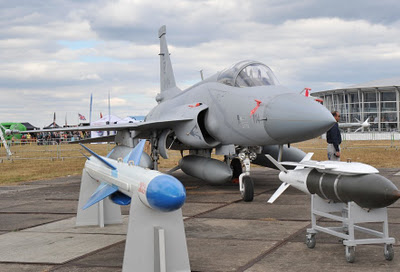
JF-17 Thunder Fighter Jet To Get Block-2 Upgrades From 2012

he JF-17 Thunder fighter, co-developed by China’s Avic and the Pakistan Air Force (PAF), is to receive improvements that will start being produced with the Block-2 version from next year.

The enhancements will effect the data link and electronic warfare capabilities. An air-to-air re refueling capability will be added, as will be new guided weapons. A two-seat variant is being developed, too. The current program schedule calls for the Pakistan-based factory to deliver the JF-17 Block-2 to the PAF from mid-2012 to 2015. Then, a Block-3 version is planned from 2016. Block-1 aircraft are being delivered until the middle of next year.


PAF Air Chief Marshall Rao Qamar Suleiman said marketing efforts focus on those countries needing to replace old fighters such as the MiG-21, early Mirage, F-5 and Phantom types. The program’s target export countries can be found in Latin America, Africa and Asia. “We offer performance comparable to U.S. and European fighters when it comes to radar, dogfight missile, range and BVR [beyond visual range] capabilities, for one third of the cost,” Suleiman claimed.


So far, five countries are said to have taken a close look at the aircraft. China itself is currently evaluating the JF-17 and a decision is expected “shortly.” Avic and the PAF expect to sell “between 300 and 500 JF-17s” over the next 10 years.


The in-service fleet has logged a total of 10,000 flight hours with the PAF. In China, the JF-17 is also known as the FC-1 Xiaolong.


Saturday, August 20, 2011

PLAN Shi Lang 83 Sea Eagle Radar


                  Phased array Radars

Fresnel-lens Based Optical Landing System


 Fresnel-lens Based Optical Landing System


1030 CIWS with tracking radar


                                   FN-3000N missile system


                           FN-3000N missile system on starboard Bow 


linkwithin

Related Posts Plugin for WordPress, Blogger...
© Copyright 2012-2013 — Asian Defence News. All Rights Reserved