Showing posts with label South Korean Airforce. Show all posts

Saturday, December 15, 2012

Boeing Demos Unmanned Little Bird for Republic of Korea Army

  • Affordable pilotless technology could expand ROKA MD 500 helicopters' mission capabilities
  • Korean Air Aerospace Division supports demonstration flight
 
Boeing demonstrated affordable unmanned aircraft technology that could be integrated onto Republic of Korea Army (ROKA) MD 500 helicopters to expand the fleet's mission capabilities.
A Boeing Unmanned Little Bird (ULB) demonstrator aircraft, a variant of the highly successful MD 500 helicopter, autonomously flew for approximately 25 minutes at the ROKA Aviation School in Nonsan. The demonstration showcased proven pilotless capabilities available for integration onto rotorcraft to support intelligence, surveillance and reconnaissance (ISR), resupply and other missions.
Korean Air supported transportation of the ULB for today's demonstration. Korea Air Aerospace Division (KAL-ASD) assembled ROKA MD 500s from 1976 to 1987 under license from Boeing heritage companies Hughes Helicopters and McDonnell Douglas. KAL delivered approximately 500 MD 500s to Hughes Helicopters, opening the Korean aircraft export market.
"Boeing and KAL continue to build on a history of collaboration to offer our customers innovative solutions, grow new business, and expand Korea's aerospace and defense industry capabilities," said Joseph Song, vice president and managing director for Boeing's defense, space and security business in the Republic of Korea.

Saturday, September 8, 2012

First look KFX Serie C103 Aircraft ( CRDC ) combination of Korean and Indonesian engineer


                                                    Model aircraft KFX / IFX serie C103 (all photos: KDN)
 
 
CRDC (Combined Research & Development Center) as an institution that formed the government of Korea and Indonesia, which is a combination of Korean and Indonesian engineer who worked together for 4.5 generation fighter jet expansion called KFX / IFX recently released the first pictures of the results cooperation both named C103 version.
C103 is a new program from the program KFX / IFX with sightings such as the F-22 Raptor with a minimized form of RCS (Radar Cross Section). The most prominent difference is the

Monday, August 6, 2012

BAE Wins South Korea Fighter Jet Upgrade Deal

AE Systems PLC  has been selected by South Korea to upgrade the nation's aging fleet of KF-16 fighter jets, the U.K. company said Monday.
A person familiar with the situation said the deal was worth around $1.1 billion, with BAE as the major beneficiary.
"This is a strategic international win for us, significantly expanding our aircraft upgrade and modification business," said Dave Herr, president of BAE Systems Support Solutions. "We have extensive capabilities that span across BAE Systems, and I am confident that our team offers the best value to the customer."
BAE will carry out the upgrades at its facilities in Florida, Texas and in Georgia, the company said in a statement.

Tuesday, July 31, 2012

BAE wins $1.05bn defence deal

South Korea has selected British defence firm BAE Systems for a 1.3 trillion won ($A1.05 billion) project to upgrade its ageing KF-16 fighter jets.
BAE Systems' US branch beat rival Lockheed Martin to win the deal, the Defence Acquisition and Procurement Agency said on Tuesday, adding a contract would be signed later this year.
BAE Systems will upgrade the mission computers and operating systems of 134 KF-16 fighters by 2021. The agency plans to select a separate firm to upgrade the warplanes' radars.
The KF-16 is a version of the F-16 built locally under licence from Lockheed Martin in the 1990s.

Tuesday, July 3, 2012

Korean Indigenous Military Helicopter Plan Gets Green Light


Despite some technical shortcomings, Korea has given the green light for the production of Surion utility helicopters ㅡ the nation’s first locally developed rotary-wing aircraft ㅡ for the military, officials said Sunday.

“Noh Dae-lae, commissioner of the Defense Acquisition Program Administration (DAPA), signed the approval for Surion helicopters on June 28, while pointing out areas of concern that need to be addressed,” DAPA spokesman Baek Youn-hyeong said.

Noh concluded that development and operational tests of the Surion helicopter demonstrated that the indigenous rotary-wing aircraft is suitable for military operations, although further performance tests are desired, the spokesman said.

The Surion project, also known as the Korea Utility Helicopter (KUH) program, is the country’s single biggest military purchase plan ever from a local contractor, the Korea Aerospace Industries (KAI).

The military, which has spent some 1.3 trillion won ($1.13 billion) for the KAI to develop the country’s first chopper over the past five years, plans to introduce about 250 with an additional budget of 6.74 trillion won.

Park Won-dong, head of the KUH program, said the state-run arms procurement agency will evaluate the effect of low temperature conditions on its performance through a flight test in Alaska next year and continue to work on some minor improvements, such as vibration reduction.

“DAPA believes that the Surion has met all requirements necessary for deployment, but will need to make modifications after further tests and monitoring to assure that our product reaches internationalstandards,” Park said.

Sources said some evaluators of the tests maintained that the high-end chopper should pass a flying test at a temperature of minus 32 degrees centigrade before it is mass produced from September 2012.

The Surion failed to pass a non-flying indoor test performed at minus 32 degrees in 2010 and 2011, but managed to pass the last one in April 2012.

Earlier, Park insisted the low temperature flying test was unnecessary since it was unlikely for thearmed forces to use the helicopter in extreme weather conditions.

However, he changed his stance as such a further evaluation and retrofit modifications would help promote exports of the made-in-Korea helicopters.

DAPA will officially announce the approval of the Surion and the results of evaluations in two weeks after completing the standardization process of the chopper for mass production, a senior DAPA official said.

“It will be terrific news to everyone, especially those who have been in the forefront of making globally competitive defense products,” he said, declining to be named. “DAPA plans to give an extensive press briefing in about two weeks to highlight the outstanding achievements in the development of the Surion, as well as to address concerns raised over production.”

An industry source said that KAI, which has been receiving orders from police and other state and public organizations, plans to produce some 24 of the new choppers by the end of 2013 and some 220 additional ones by the end of 2017 for the armed forces.

“As KAI did for the development of the T-50 supersonic trainer jet, it will continue to upgrade the Surion through a set of new studies and evaluations, including the low temperature field test,” he said.

Technical Specification of Surion helicopter
  • Crew: 2 pilots + 2 gunners + 9 troops or 2 pilots + 16 troops
  • Length: 19 m (with main rotor), 15.09m (without Rotor)
  • Height: 4.5 m
  • Empty weight: 4,973kg
  • Max. takeoff weight: 8,709 kg
  • Maximum cruising speed: 259 km/h
  • Operational range: 480 km

Monday, June 25, 2012

Missteps Plague South Korean Fighter Jet Contest

SEOUL, South Korea — South Korea’s multi-billion-dollar project to acquire 60 new combat aircraft is facing delays following controversies over the fighter jet evaluation methods and mistakes in how the bids were submitted.
 
In the latest fiasco, the 8.3 trillion won ($7.2 billion) contest was postponed June 19, just one day after the three bidders — Lockheed Martin, Boeing and EADS — submitted their proposals for the F-X III contest, whose winner is to be announced in October. That’s because the proposals by Lockheed and EADS failed to meet translation requirements, according to South Korea’s Defense Acquisition Program Administration (DAPA).
 
Lockheed is offering the F-35 Joint Strike Fighter, Boeing the F-15SE Silent Eagle and EADS the Typhoon.
 
Four of the 24 files Lockheed submitted, related to offset programs and the prices of key equipment, lacked documents translated into Korean, while EADS’ 32 files were mostly in English with only an executive summary in Korean, the agency said in a statement.
 
The decision fanned the possibility that the fighter procurement plan would not meet its schedule.
 
“The F-X III selection will be two weeks behind schedule inevitably, due to the translation problem, which means DAPA’s fighter evaluation, set to begin early July, is to be postponed,” said Kim Dae-young, a research member of the Korea Defense & Security Forum, a private defense think tank here. “We already don’t have much time for evaluation and price negotiation.”
 
Earlier, the contest came under controversy over the evaluation methods planned for the F-35, which has long been considered the front-runner due to its “fifth-generation” capability.
 
DAPA’s evaluation team decided to test the F-35 through the use of simulators, since the U.S. government doesn’t allow pilots from potential customers to fly the single-engine stealth plane, which is still about 20 percent of the way through its testing program.
 
Critics argue, however, that simulator evaluations cannot prove the performance of a fighter jet in a proper manner, especially since the aircraft is still being developed.
 
Rumor and speculation also arose that the administration of President Lee Myung-bak is trying to give preference to the U.S. fighter jet over the Typhoon, the product of Eurofighter, a four-nation European consortium.
 
“Unlike the simulation of a commercial airplane, it’s almost impossible to demonstrate high-mobility features and technologies of a fighter jet,” said Shin Bo-hyun, head of the Weapons System Concept Development and Application Research Center at Konkuk University here.
 
Shin, a retired South Korean Air Force major general, said, “A big question is what functions are to be evaluated through simulation, even though the F-35 program development is still in limbo.”
 
Facing a barrage of public criticism over the “rough-and-ready” fighter competition, Noh Dae-rae, commissioner of the DAPA, backed down, saying the fighter selection schedule could be delayed.
 
“Making a decision by October is our goal, not an obligation, for effective negotiations,” Noh said. “But if we need more time to verify candidates and negotiate with bidders, we’re not really obliged to that timeline.”
 
He also hinted that his agency would demand that the U.S. government allow a South Korean pilot to fly an actual F-35.
 
Lockheed officials still have confidence that their high-fidelity simulators, including the F-35 manned tactical simulator and handling qualities simulator, will offer a great deal of access to the F-35 system.
 
“In the past, when we have a fighter aircraft with two seats, the second seat was required to be used for training purposes, but today’s technology allows us to build a single-seat airplane because today’s simulators are very precise and accurate,” Randy Howard, director of Lockheed’s F-35 campaign in South Korea, told Defense News.
 
“We’re confident that South Korean pilots can fly our simulators and fully understand the aerodynamics and operational capabilities of the F-35,” he added.
 
Boeing has yet to firm up its arrangements for the F-15SE evaluation, with doubts hanging over the twin-engine plane’s ability to perform both traditional and stealthy functions.
 
“Many of the key capability elements of the Silent Eagle are already well along with the development as part of the F-15 international programs that are ongoing,” said Howard Berry, Boeing’s vice president for sales. “In that point, Korea is actually in a tremendous position, giving the timing of their acquisition to leverage other ongoing development activities funded by other F-15 customers worldwide.”
 
EADS is confident in the F-X III testing and evaluation procedures, since hundreds of Typhoon fighters have already entered service.
 
“You can feel a large gap obviously between flying an actual aircraft and testing simulator programs,” an EADS official said. “We’re confident in the deal, as long as the competition is to proceed with fairness.”
 
The European aerospace giant is proposing that South Korea become the world’s fifth nation to produce the twin-engine, multirole combat aircraft, following Britain, Germany, Italy and Spain.
 
The company links the F-X deal to Seoul’s fighter development plan codenamed KF-X, aimed at producing more than 200 multirole, stealthy aircraft.
 
“Key technology challenges related to the KF-X development are common to F-X key technologies and enhancement roadmaps,” Thomas Linkenbach, vice president of air systems portfolio management and sales for Cassidian, the EADS unit leading the Typhoon campaign in South Korea, said in a June 19 forum. “F-X procurement offers the best opportunity for the Republic of Korea to pave the way towards the technological challenge a fighter development imposes.”
 
He referred to several fighter technologies that could be transferred to South Korea. Among them are developing low-observable configurations, radar signature analysis and testing, radar-absorbing structure technology, advanced fighter control law design, and the integration of active electronically scanned array radars.

Sunday, June 24, 2012

Elbit to upgrade South Korean C-130 transports

Tel Aviv - Elbit Systems has been awarded a $62 million contract to upgrade South Korea's inventory of Lockheed Martin C-130 tactical transports.
 
To be conducted in cooperation with Korea Aerospace Industries, the contract will lead to the Republic of Korea Air Force's C-130s receiving advanced electronic systems and new glass cockpits, with the latter to include Elbit digital flight displays.
 
Announced by the Israeli company on 24 June, the project will be performed over a four-year period.
 
South Korea has an active fleet of 12 C-130H Hercules, including four stretched-fuselage -30 examples, says Flightglobal's MiliCAS database. It records these as having been delivered between 1987 and 1990. It also has four new-generation C-130Js on order, with deliveries expected from 2014.
 
Yoram Shmuely, co-general manager of Elbit's aerospace division, says the company hopes its new contract with Seoul will create the potential for additional deals with legacy C-130 operators. It has also previously conducted modernisation work on the type for Romania.

Friday, June 22, 2012

South Korean Jets For The Philippines


The Philippines has ordered twelve South Korean TA-50 armed trainers for $49 million each. The price includes training, spare parts and some tech support. The single engine, two seat aircraft is intended to restore jet combat aircraft capability in the Philippines Air Force. The first TA-50 will be delivered next year, and the last of them the year after that.
The TA-50 is the combat version of the South Korean designed and manufactured T-50 jet trainer. This aircraft was developed over the last decade, at a cost of over two billion dollars. The first test flight of the T-50 took place in 2002. The 13 ton aircraft is actually a light fighter and can fly at supersonic speeds. With some added equipment (radars and fire control), the T-50 becomes the TA-50, a combat aircraft. This version carries a 20mm auto-cannon and up to 4.5 tons of smart bombs and missiles. The T-50 can stay in the air about four hours per sortie and has a service life of 8,000 flight hours.
Seven years ago the Philippines removed from service its eight F-5 fighters. These 1960s era aircraft were not much of a match for more recent warplanes and were expensive to maintain. In the meantime, the Philippines used armed trainer aircraft for strikes against Moslem and communist rebels.
Four years ago the Philippines Air Force bought another 18 Italian SF-260 trainers, for about $812,000 each. The SF-260 has been around for over 40 years and about a thousand have been produced. This is a 1.1 ton, two seat aircraft, with a max speed of 347 kilometers an hour, and an endurance of about six hours. It can be equipped to carry a 100-150 kg (220-330 pounds) of weapons and be used as a light attack aircraft. The Philippines had previously bought 64 SF-260s and has been using them for decades. Because of operational losses and wear-and-tear few are still in service.
Back then things were pretty desperate, or at least more desperate than usual, for the air force. The rising price of oil has forced sharp cutbacks in maritime patrol flights by its five Italian made S211 jet trainers. These five aircraft also served as the only fighter aircraft the Philippines had. The Philippines bought more helicopters, which were very useful in fighting Moslem and communist rebels. The Philippines originally bought 25 S211s in the 1980s but due to accidents and lack of maintenance only about five were available for service most of the time.
The 2.7 ton S211s have a max speed of 665 kilometers an hour and can stay in the air for about five hours per sortie. The S211s were not really doing much with the maritime reconnaissance flights, as the aircraft lacked search radar and depended on the eyes of the two pilots to spot anything. The SF-260s replaced the remaining S211s.

Monday, June 18, 2012

Strike Aircraft Bid For South Korean Fighter Contract

Three of the world's most capable jets are competing to become South Korea's new frontline combat aircraft. These are the Lockheed Martin F-35 Lightning II Joint Strike Fighter, the Eurofighter Typhoon and the Boeing F-15SE Silent Eagle.

Each is now being assessed by South Korean defence officials for the third stage of the Republic of Korea Air Force's F-X Fighter Program.

The Boeing F-15K Slam Eagle has already won F-X Fighter Program stages one and two, having been judged the best choice for South Korea's future fighter needs. Now, the Republic of Korea Air Force is seeking a new advanced multirole strike platform and the deadline for bids ended today - 18 June 2012.

Flight tests are scheduled for September and, one month later, the winner should be announced.

South Korean Fighter Contract

The South Korean fighter contract will involve the purchase of 60 new multirole combat aircraft. While Europe and the US remain in financial difficulties, increasing Asian wealth is helping drive growth in many areas, defence included. Indeed, business research firm Frost & Sullivan expects defence spending in the Asia-Pacific region to rise 4.2 per cent every year until 2016.

Various factors could influence which, of the three combat aircraft, South Korea selects. Having previously gone for a different version of the well-established Boeing F-15 on two occasions, it could be swayed this way again.

South Korean Strike Aircraft Bids

On the other hand, Eurofighter's widely-expected to soon announce a plan that could see Typhoons constructed under licence - if the type wins the South Korean strike aircraft bids process - and that could be a boon to the local economy. The Eurofighter Typhoon currently equips the Royal Air Force, Royal Saudi Air Force, Austrian Air Force, German Air Force, Italian Air Force and the Spanish Air Force, so is the most widely-used of the three designs.

The F-15SE Silent Eagle is, by contrast, not yet in service and first flew in July 2010, but it's based on the very well-established F-15E Strike Eagle. With advanced stealth features including radar-absorbent materials, it's being pitched at operators currently equipped with the F-15E Strike Eagle - Japan and Israel among them.

The F-35 Lightning II Joint Strike Fighter is also under development and some months away from entering service. It's the product of a multi-national collaboration programme led by the United States, which plans to purchase well over 2,000 examples in three variants.

Wednesday, June 13, 2012

South Korea has ordered 367 CBU-105 sensor fuzed weapons from the United States


South Korea has ordered 367 CBU-105 sensor fuzed weapons from the United States. Average cost is $900,000 each, including maintenance, training, and equipment, plus spare parts and training bombs. This is part of a South Korean buildup to deal with a possible North Korean invasion, or messy collapse and civil war in the north. That might include a war with China.
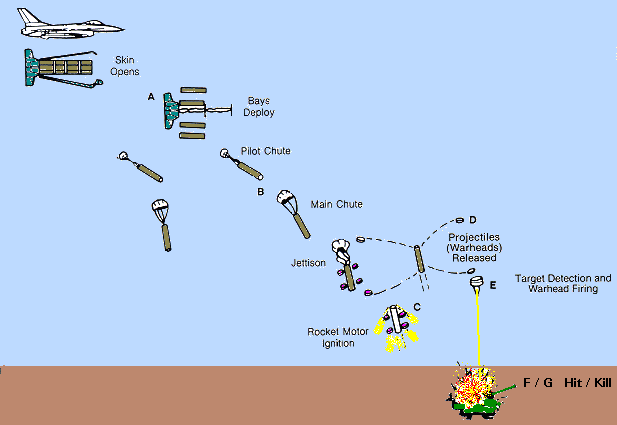
First used during the 2003 Iraq war, the CBU-105 Sensor Fuzed Weapon is a cluster type bomb that releases computer controlled and radar equipped BLU-108 submunitions that hunt for armored vehicles below and destroy them. Each submunition is, in effect, a little robot programmed to find and destroy vehicles below. The CBU-105 can be used to attack formations of tanks, giving most of the submunitions an opportunity to destroy a vehicle. South Korea will equip some of its T-50 jet trainers with the CBU-105. The T-50 is designed to also operate as a bomber or fighter.
CBU-105 is a half ton, GPS guided bomb carrying ten BLU-108 submunitions, each of which uses a parachute to slowly descend. The submunition radar seeks out armored vehicles. If it spots one the guidance system maneuvers the submunition towards the vehicle and fires a shaped charge that generates a self-forging warhead that is basically a bolt of molten metal travelling at high speed. This penetrates the thinner top armor of the vehicle and messes up the insides. This is similar to the Iranian shaped charge IEDs used in Iraq. If the submunition radar does not spot (via its internal computer and library of vehicle types) a tank or other armored vehicle, it attacks any vehicle within a hundred meters or so. If there are no vehicles the submunition detonates on the ground so that it does not lie around the battlefield causing a hazard. The BLU-108 is designed so that fewer than one percent of them will land and not detonate. These unexploded bomblets are a danger to anyone living or passing through the area.
The BLU-108 was developed at the end of the Cold War, to be a major weapon against the thousands of Russian tanks aimed at Western Europe. Development was not completed until the late 1990s, and the U.S. Air Force reduced its purchasing plans from several hundred thousand BLU-108s to less than 50,000

Wednesday, April 11, 2012

Korea Aerospace Industries T 50 aircraft


The T-50 was developed by Korea Aerospace Industries, Ltd., with cooperation and global marketing support from Lockheed Martin. Both firms were aware that many training aircraft fleets are aging, even as higher-performance fighters demand trainer aircraft that can keep up. The Korean government needed a fleet of trainers, and saw an opportunity to give their aerospace sector a strong boost in the process. Total investment in the T-50’s RDT&E program amounted to more than $2 billion: 70% from the Korean government, 17% from KAI, and 13% from Lockheed Martin.

With a length of 43 feet and a wingspan of 30 feet, the 2-seat T-50 is about 4 feet shorter than the F-16; overall, it’s only about 80% of the F-16’s size. The relative size of the control surfaces and tails are larger, however, to improve handling characteristics at lower speeds and make the aircraft easier to land. Larger landing gear is also fitted, to absorb harder landings, which is to be expected from student pilots. Its form’s resemblances to Lockheed Martin’s F-16 are suggestive, and include the blended mid-set wing, complete with leading-edge root extensions and rear ‘shelf’ fairings ending in F-16-style split airbrakes.

Wednesday, October 12, 2011

KAI T-50 Golden Eagle

The T-50 Golden Eagle is a family of South Korean supersonic advanced trainer and multirole fighters, developed by Korea Aerospace Industries beginning in the late 1990s. The T-50 is the first indigenous South Korean supersonic aircraft and one of the only supersonic trainer in the world. It took its first flight in 2002 and went active duty with the Republic of Korea Air Force in 2005.
 The T-50 advanced trainer developed into acrobatic and combat variants, namely the T-50B, TA-50 and FA-50. Ten T-50B to serve with the Air Force aerobatics team, South Korea. In 2011 was the first squadron of the TA-50, T-50 light attack variant is, operational. The first flight of the FA-50, T-50's multirole fighter version with similar capabilities for KF-16, also continued in 2011. First FA-50 production for 60 aircraft starting in 2013 to 2016.
As of 2011, sixteen TA-50 light attack variants of the family has been exported to Indonesia, and additional export orders are pursued in countries such as Iraq, Israel, Poland, the Philippines, and Spain. T-50 is also marketed as a candidate for the TX program of the United States and the United States Air Force's next-generation advanced trainer. The T-50 is the proposed basis for the F-50 next-generation indigenous fighter.

 The T-50 program was originally designed for an indigenous trainer aircraft capable of supersonic flight to develop, and train pilots to prepare for the KF-16 and F-15K to replace coaches such as T-38 and A -37 which was in service with the Republic of Korea Air Force. Prior South Korean aircraft programs, the propeller-driven basic trainer KT-one produced by Daewoo Aerospace (now part of KAI), and license manufactured KF-16. In general, the T-50 series of aircraft similar to the KF-16 in configuration.
 The mother program, codenamed KTX-2, began in 1992, but the Ministry of Finance and Economic Affairs KTX-2 suspended in 1995 due to financial constraints. The basic design of the aircraft was established in 1999. The development of the aircraft was funded by Lockheed Martin 13%, 17% by Korea Aerospace Industries (KAI), and 70% by the government of South Korea.

The aircraft was formally designated as T-50 Golden Eagle in February 2000. The T-50A designation is reserved by the U.S. military to avoid inadvertently assigned to another aircraft model. Final assembly of the first T-50 took place between January 15 and September 14, 2001.  The first flight of the T-50 took place in August 2002 and the first operational assessment from July 28 to August 14, 2003. KAI and Lockheed Martin are currently pursuing a joint marketing program for the T-50 variant at international level. The South Korean Air Force placed a production contract for 25 T-50s in December 2003, with planes scheduled to be delivered between 2005 and 2009. Original T-50 equipped with the AN/PG-67 (V) 4 radar from Lockheed Martin.


 he T-50 Golden Eagle design is largely derived from the Lockheed Martin F-16 Fighting Falcon, and they have much in common: use of a single motor, speed, size, cost and range of weapons. Previous techniques KAI's experience in producing the license KF-16 has benefited significantly in the T-50 design.

The trainer can carry two pilots in tandem seating. The high-mounted hood developed by Hankuk Fiber is used with stretched acrylic, which the pilots with good visibility, and is tested to the hood with a ballistic protection against 4-lb objects affects 400 knots to offer. The height limit is 14,600 meters (48,000 ft), and the hull is designed to provide 8000 hours of service. There are seven internal fuel tanks with a capacity of 2,655 liters (701 U.S. gal), five in the trunk and two in the wings. An additional 1710 liters (452 ​​U.S. gal) of fuel can be performed in the three external fuel tanks.


The T-50 Golden Eagle uses a General Electric F404-102 turbofan engine produced under license by Samsung Techwin, upgraded with a Full Authority Digital Engine Control (FADEC) system jointly developed by General Electric and Korea Aerospace Industries. The engine consists of three-staged fans, seven axial stage arrangement, and an afterburner. The aircraft has a maximum speed of Mach 1.4-1.5. The engine delivers a maximum of 78.7 kN (17,700 lbf) of thrust with afterburner. The General Electric F414 engine has been proposed as the new engine for the T-50 family, but also Rolls Royce EJ200 for better compatibility with the European air forces. Both engines deliver more thrust compared to the F404.

The T-50's central processing unit and the operating system developed by MDS technology. [40] The T-50's avionics system is the first and only real-time operating system developed by an Asian company, and receives the DO-178B certification. Samsung Thales and LIG Nex1 are the main avionics and electronic warfare equipment developer for T-50 and its variants. Other South Korean companies such DoDAAM Systems and Aero Master are responsible for the secondary of the aircraft avionics, including store management computers, avionics test equipment, flight data recorders, portable maintenance aids, data analysis software, post-flight data processing system, and aircraft structure and engine management software.


Hanwha provides the mechanical components for the operating system, and WIA provides the base. The T-50 is equipped with a Honeywell H-764G embedded global positioning / inertial navigation system and HG9550 radar altimeter. The aircraft is the first coach of the digital fly-by-wire control interface (triple redundant) function. The cockpit panels, switches and joysticks are produced by the South Korean FirsTec and Sungjin Techwin.


TA-50 mounts a General Dynamics A-50 20 mm gun internally behind the cockpit. The gun is a three-barreled version of the M61 Vulcan, with 205 rounds of link less ammunition. AIM-9 Sidewinders can be connected to each wingtip rails, and additional weapons can be mounted under wing hard points. Compatible air-ground weapons are the AGM-65 Maverick missiles, Hydra 70 rocket launchers and LOGIR, CBU-58 and Mk-20 cluster bombs, and Mk-82, -83, -84, and general purpose bombs.


FA-50 can be externally provided with Rafael's Sky Shield LITE NING ECM pods and targeting pods to further improve the fighter electronic warfare and targeting capabilities. Other improved weapon systems over TA-50 are multifunctional SPICE guidance kits, Textron Sensor Fuzed Weapon with CBU-97/105 WCMD tail kits, JDAM-ER and JDAM for more extensive air-ground operations, and AIM-120 missiles for BVR air to air operations. FA-50 has provisions for but not yet integrated, Python and Derby missiles, also manufactured by Rafael.


General characteristics
Crew: 2 

Length: 12.98 m (42 ft 7 in) 
Wingspan: 9.17 m (30 ft 1 in) 
Height: 4.78 m (15 ft 8.25 in) 
Empty weight: 6,450 kg (14,200 pounds)
Max takeoff weight: 13,500 kg (29,700 pounds) 
Powerplant: 1 × General Electric F404 afterburning turbofan
Dry thrust: 53.07 kN (11,925 lbf)
Thrust with afterburner: 78.7 kN (17,700 lbf)

Performance
Maximum speed: Mach 1.4 ~ 1.5

Range: 1.851 km (1.150 mi) 
Ceiling: 16,760 m (55,000 ft) 
Thrust / weight: 0.96Max g limit: -3 g / 8 g

Weaponry 

Guns: 1 × 20 mm (0.787 in) 
General Dynamics A-50 three-barreled rotary cannon 
Hard Points: Total: 7 
Rockets: Hydra 70, LOGIR 
Rockets:Air-to-air: AIM-9 Sidewinder, AIM-120 AMRAAM. 
Air-ground: AGM-65 Maverick
Bombs: Mk 82, Mk 83 and Mk 84 general purpose bombs with SPICE, JDAM or JDAM-ER guidance kits; CBU-97/105 sensor fuzed weapons, laser guided bombs

Wednesday, August 31, 2011

South Korea Unveils First Surveillance Aircraft


As a hope of making another great leap in improving South Korea’s military might, South Korea’s first surveillance airplane, known as Airborne Early Warning and Control plane, arrived at an Air Force base on Aug. 1.
 
The Defense Acquisition Program Administration (DAPA) in Seoul said that a Boeing E-737 early-warning and control aircraft landed at the Air Force base in Gimhae, South Gyeongsang, after completing tests by South Korean Air Force at Boeing’s factory in Seattle.
 
“It will go through test flights and acceptance tests before it’s handed over to our Air Force in early September,” the DAPA said.
 
In an effort to establish autonomous early-warning and control system, South Korean military had decided to adopt E-737 in November 2006. Since then Seoul has been doing its effort to bring four such planes by end of 2012. Currently, Korea Aerospace Industries, the nation’s leading aircraft maker, is developing advanced multi-purpose electronic satellite radar system that will be installed in the second, third and fourth planes. They are planned to be handed over to South Korean Air Force in 2012.
 
“If necessary, early-warning and control airplane is capable of monitoring the whole land of North Korea,” said a defense official at the Defense Ministry in Seoul. “Not only the plane can monitor target areas real-time, but also it can improve airborne operations significantly by assisting air-defense system on ground. The surveillance plane will also be capable of checking airborne or seaborne targets on the entire Korean Peninsula, and will be able to catch aircraft flying at low altitude infiltrating mountainous areas.”
 
A 120-seater E-737 surveillance aircraft was made by remodeling Boeing 737 passenger plane, such as installing Multi-role Electronically Scanned Array (MESA) Surveillance Radar on top of plane body and radar manipulating consol system inside the aircraft. DAPA said such systems are capable of detect, distinguish, monitor and analyze targets in the air and on sea spontaneously. When new E-737 plane is in full operation, it will observe whole operational area and provide core information of enemies to South Korea’s fighters and warships.
 
Apart from a old early warning and control plane, the new E-737 aircraft uses electronically scanned array radar which is capable of not only covering omni-directional area but also focusing on a specific target exploration. Experts anticipate that the use of the new plane could upgrade South Korea’s military power significantly. They also hope that the plane could contribute in improving independent intelligence gathering and monitor capabilities after the transition of wartime operational control from the United States to South Korea.
 
The new E-737 has a flying range of around 7,000 kilometers (4,349 miles) and it can fly on patrol for about eight to nine hours. MESA radar can detect and monitor some 1,000 target planes at the most. It also has a capability of interlocking with strategic data link system of Air Force air-defense units.
 
The aircraft has been dubbed “Peace Eye” after a naming contest in 2008. It has a meaning of demonstrating peace missions in and out of the Korean Peninsula where it remains the only divided land in the world.
 

Thursday, August 25, 2011

South Korea receives three F-15K Slam Eagles

South Korea has taken delivery of three more Boeing F-15K Slam Eagles, with the final eight of its 2008 21 aircraft order to be delivered before April 2012.
 
The aircraft departed Boeing's St Louis production facility on 16 August and arrived at Daegu AFB on 20 August, said Boeing.
 
During the transit the aircraft stopped in Palmdale, California, Hickam AFB, Hawaii and Andersen AFB, Guam. Their tail numbers are 51, 52 and 53.
 
In 2010 Boeing delivered six F-15Ks, with a further four arriving in April and May 2011.
 
Under its F-X II requirement South Korea ordered 21 F-15Ks in 2008. The South Korean air force had previously acquired 40 of the two-seat aircraft, before signing a follow-on order in 2008 for the 21 new, Pratt & Whitney F100-229-powered examples.
 
In late July, Seoul's Defence Acquisition Program Administration shortlisted four possible replacements to meet its F-X III upgrade programme requirements: Boeing's F-15 Silent Eagle, Lockheed Martin's F-35 Lightning II, the Eurofighter Typhoon and Sukhoi's developmental PAK-FA.
 
Boeing and Lockheed Martin said that they both expect a formal request for proposal for 60 aircraft in early 2012, with deliveries to start in 2016.

Sunday, March 6, 2011

South Korea - Air Force unveils 1st airborne early warning plane - Boeing E-737 Peace Eye

Royal Australian Air Force - Boeing E-737 Peace Eye- South Korean Airforce has purchased a similar aircraft weapons system.

 The South Korean Air Force’s first airborne early warning and control aircraft, the E-737 Peace Eye, has been unveiled at Boeing’s factory in Seattle.

A taegeuk mark symbolizing Korea along with the letters of the South Korean Air Force were clearly seen on the side of the aircraft Thursday last week. The early warning aircraft detects enemy movements from a distance for reporting to a ground base and controls the combat planes of friendly forces.

Seoul decided in 2006 to purchase four E-737s for 1.6 billion U.S. dollars. The first one will be delivered in June and the remaining three by year`s end.

Boeing’s E-X program manager Randy Price said, “A ground radar base has difficulty detecting flying objects behind mountains and is vulnerable to aircraft flying at a low altitude, such as the AN-2 of North Korea, but the E-737s can overcome these shortcomings because they detect enemy flight in the air.”

“They are movable radars fitting the terrain of the Korean Peninsula.”

A 10-meter long antenna called MESA is attached to the top of the aircraft. Price said, “Previously, a radar in the shape of a cylinder circled every 12 seconds to detect enemy objects. In contrast, the MESA radar shoots beams in all directions simultaneously, so there is no blind spot in monitoring.”

An early warning airplane can monitor all objects in the airspace above the Korean Peninsula simultaneously. Seoul, however, has purchased four units as one airplane can fly for eight hours considering fuel and crew fatigue.

If three planes take turns in operations on a given day, the remaining one can undergo maintenance for the next operation.

linkwithin

Related Posts Plugin for WordPress, Blogger...
© Copyright 2012-2013 — Asian Defence News. All Rights Reserved