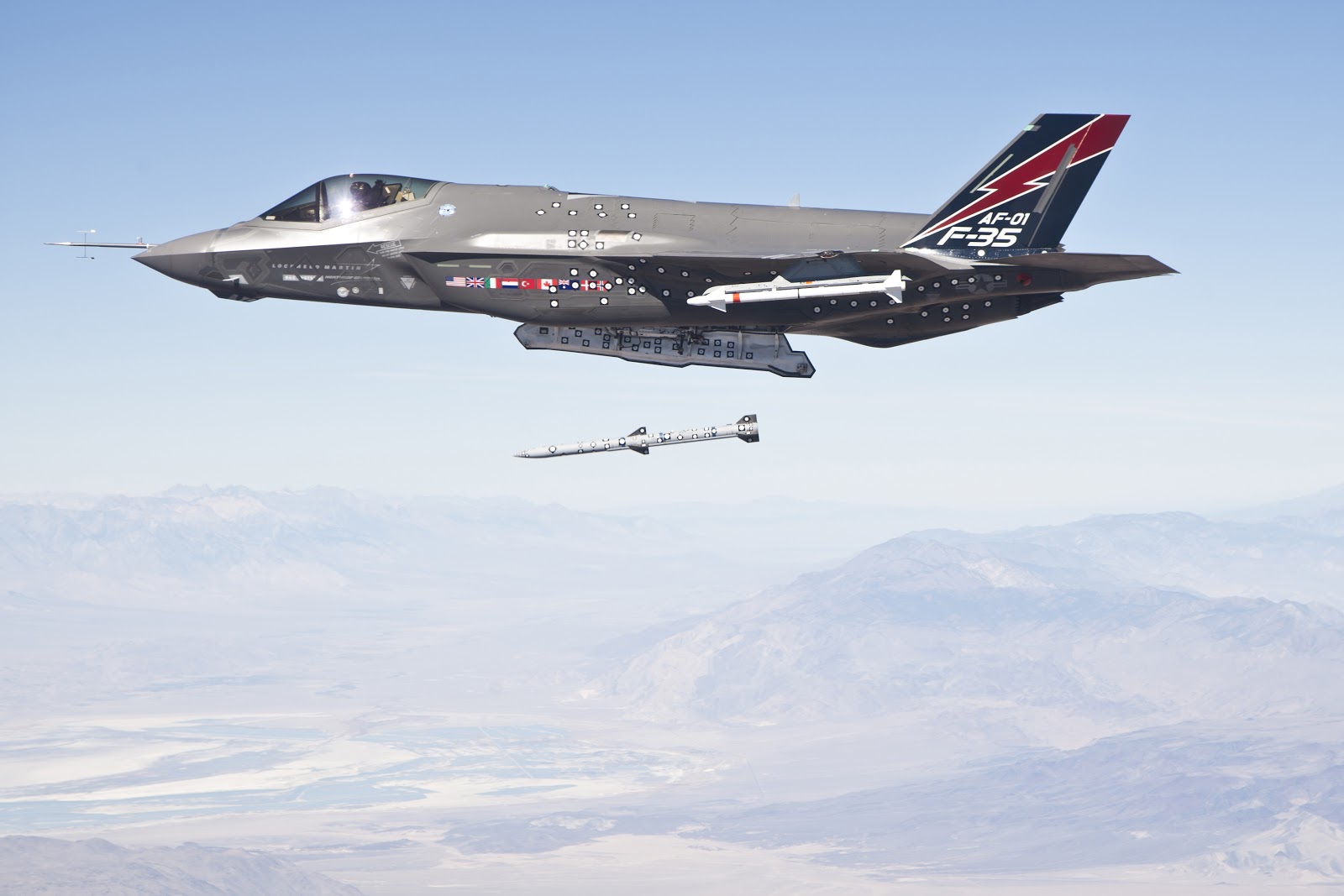
The production of the F-35 Joint Strike Fighter
– the world’s most sophisticated and expensive combat aircraft – has been
derailed after engineers discovered that the jet’s fuel tank could explode
if struck by lightning.
The disclosure is a major setback for the aircraft, also known as the
Lightning II, which is due to enter service with both the RAF and the Royal
Navy by 2018.
Attempts to increase fuel efficiency by reducing the jet’s weight have also
made it more vulnerable to enemy attack than the generation of aircraft it
was supposed to replace.
The damaging findings were disclosed in a Pentagon document which revealed
that a fault within the JSF’s fuel tank could potentially lead to
catastrophic explosion if the aircraft was struck by lightning in a
thunderstorm.
The report from the Pentagon’s Operational Test and Evaluation Office states
that all test flying within 25 miles of thunderstorms is “not permitted”
until a device in the fuel tank which maintains correct oxygen levels is
redesigned.
The fear of an exploding fuel tank is just one of a series of problem to befall the F-35 programme. A design fault in the fuel tank has also prevented the JSF being able to rapidly descend to low altitude.
The Pentagon report describes both failings as “unacceptable for combat or combat training”.
Examinations by the United States Air Force and the Lockheed Martin, the aircraft’s manufacturer, also discovered a handful of cracks in the tested aircraft, including on the right wing and right engine of the F-35A variant, and on another part of the F-35B variant.
“All of these discoveries will require mitigation plans and may include redesigning parts and additional weight,” the report added.
Britain is buying the F-35B – the short take-off and vertical landing version – as a replacement for the Harrier. The “multirole” plane will be used for air defence, ground attack and reconnaissance missions.
The F-35 has a top speed of 1,300mph and a range of 1,450 miles, while the Harrier could reach a speed of 700mph and had a range of 350 miles. The older aircraft also had no radar transparency or stealth capabilities, while the F-35 has both.
The fear of an exploding fuel tank is just one of a series of problem to befall the F-35 programme. A design fault in the fuel tank has also prevented the JSF being able to rapidly descend to low altitude.
The Pentagon report describes both failings as “unacceptable for combat or combat training”.
Examinations by the United States Air Force and the Lockheed Martin, the aircraft’s manufacturer, also discovered a handful of cracks in the tested aircraft, including on the right wing and right engine of the F-35A variant, and on another part of the F-35B variant.
“All of these discoveries will require mitigation plans and may include redesigning parts and additional weight,” the report added.
Britain is buying the F-35B – the short take-off and vertical landing version – as a replacement for the Harrier. The “multirole” plane will be used for air defence, ground attack and reconnaissance missions.
The F-35 has a top speed of 1,300mph and a range of 1,450 miles, while the Harrier could reach a speed of 700mph and had a range of 350 miles. The older aircraft also had no radar transparency or stealth capabilities, while the F-35 has both.