Showing posts with label JF17. Show all posts

Saturday, February 9, 2013

DESPITE Missile Integration, Nuke Unlikely Role for Pakistan's JF-17

Pakistan is integrating its nuclear-capable Hatf VII/Vengeance VII Ra’ad air launched cruise missile onto its JF-17 Thunder aircraft, but analysts are unsure if this signifies a nuclear deterrence role for the aircraft.

Air Commodore Khalid Mahmood at the JF-17 Project Management Office said integration work was ongoing with Chinese and Pakistani weapons, and that “most weapons have been integrated”.

“Ra’ad and the H-4 [glide bomb] will be for the Block I and Block II” aircraft currently in or about to enter service, not just the forthcoming Block III variant, he said.

Former Air Force pilot and analyst Kaiser Tufail said, “It makes good sense to get on with the wiring as well as flight trials of these weapons on the JF-17 at this stage. For one thing, all subsequent production aircraft would have the mod integrated from the outset and there will be no need for retrofits that also result in long down times at the flight lines. Secondly, the whole process is lengthy and it was about time we started it.”

He added, “Possibly, by the time the mods are in place on the JF-17, the first of the older Mirages would be retiring.”

The Mirage III carries the Ra’ad and is the delivery platform for Pakistan’s airborne arm of its nuclear deterrent. Its avionics were upgraded in the 1990s under the Retrofit Of Strike Element (ROSE) program.

They have been in service for many years, however, and are approaching the end of their useful lives.

Most recent major military developments have aimed to strengthen the nuclear deterrent, such as the unveiling of the Hatf IX/Nasr battlefield ballistic missile and the submarine-launched variant of the Babur cruise missile.

Wednesday, June 13, 2012

World's best jet fighters

1. F/A-22 Raptor

 The F/A-22 Raptor is a fifth generation stealth fighter aircraft, which entered the United States Air Force as the F-22A. Manufacturer: Lockheed Martin Aeronautics and Boeing Integrated Defense Systems Engine Specifications: Two Pratt & Whitney F-119-PW-100 Turbofan engines with afterburners and two-dimensional thrust-vectoring nozzles. Each Engine is in the 35,000-lb-thrust class. Maximum Speed: Mach 2.42 at high altitude Cruise Speed: Mach 1.72.  This pilot only aircraft can carry six radar-guided AIM-120C advanced medium-range A2A missiles in its main weapon bay, two heat-seeking AIM-9 Sidewinder short-range A2A missiles in side weapons bay, one M61A2 20 mm multi-barrel cannon. With this much onboard, the plane still manages to carry four external stations with additional arsenal.

2. B2 Spirit

 The B2 Spirit is a multi-role stealth bomber which is capable to drop conventional and nuclear weapons. The development of this aircraft can be seen as a milestone in the bomber modernization program of the U.S. Department of Defense. Manufacturer: Northrop Corporation and Northrop Grumman. Engine Specifications: Four General Electric F118-GE-100 non-afterburning turbofans each providing it with 19,000 lb thrust. Maximum Speed: Mach 0.92.  The B-2 provides the versatility inherent in manned bombers. The aircraft comes with unique 'stealth' characteristics that give it the ability to hide itself from enemy's most sophisticated defenses enabling it to attack right from the enemy's prime locations. The B-2 can carry a crew of 2-3 soldiers along with up to 80,000 lb payload including 16 B61/b83 nuclear bombs, 80 Mk82 1,000 lb bombs or 16 Mk84 2,000 lb bombs, 36 M117 750 lb fire bombs, 36 cluster bombs, or 80 Mk36 1,000 lb sea mines.

3. Su-47

 The Sukhoi Su-47 was also called as S-37 and S-32 during initial development. The aircraft has been fully developed but till now it has not entered service. Manufacturer: SukhoiEngine Specifications: Two Aviadvigatel D-30F6 afterburning turbofans. The company plans to incorporate two Saturn / Lyulka AL-37FU afterburning Turbofans in it. Maximum Speed: Mach 2.09 at high altitude Maximum Cruise Speed: Mach 1.17. This pilot only aircraft can carry one 30mm GSh-30 cannon, R-27/AA-10 Alamo A2A missile, and R-73/AA-11 Archer A2A missile.


4. MiG-35

 The Milkoyan MiG-35 is a mature development of MiG-29M. The aircraft has also been fully developed and is on offer; however it still has not entered service. Manufacturer: MilkoyanEngine Specifications: Two Lyulka AL-41F vectored-thrust afterburning turbofans, 39,340 lb thrust each. Maximum Speed at high altitude: Mach 2.05 Maximum Cruise Speed: Mach 1.02.  One 30 mm GSh-30-1 cannon with 150 rounds, eight weapons pylons for R-27, R-60, R-73, R-77, TV and Laser-Guided Air to Ground missiles and bombs. In addition, the aircraft can also carry up to 2,000 lb of bombs.

5. F-117A Nighthawk

 The F-117A Nighthawk is the world's first operational aircraft designed to exploit low-observable stealth technology. Manufacturer: Lockheed Martin Engine Specifications: Two General Electric F404-F1D2 turbofans which offer 10,600 lbf each. Maximum Speed: Mach 0.92. The single-seat F-117A provides exceptional combat capabilities. It is designed to carry 2 internal weapons bays with one hardpoint each, which can further carry BLU-109 hardened penetrator bombs, GBU-10 Paveway II, GBU-12 Paveway II and GBU-27 Paveway III laser-guided bombs and JDAM inertially aided munition

6. F-35 Lightning II

 The F-35 Lightning II is a single-seat, single-engine military strike fighter. Its multi-role capabilities enable it to perform close air support, tactical bombings and air-to-air combat. Manufacturer: Lockheed Martin Aeronautics, Northrop Grumman, BAE Systems. Engine Specifications: One Pratt & Whitney F135 afterburning turbofan that offers 28,000 lbf as dry thrust and 43,000 lbf with afterburner support. Maximum Speed: Mach 1.8.  The F-35 Lightning II is designed to carry 1 GAU-12/U 25 mm cannon, up to four AIM-120 AMRAAM, AIM-9X Sidewinder or AIM-132 ASRAAM internally or two air-to-air and two air-to-ground weapons. The aircraft is detectable by Radar so it can also carry many more missiles, bombs and even fuel tanks.

7. F-16 Fighting Falcon

 This is a multirole jet fighter designed for the United States Air Force. The aircraft was also successful in the export market and is serving 24 countries. Manufacturer: General Dynamics and Lockheed Martin Engine Specifications: One Pratt & Whitney F100-PW-220 afterburning turbofan which offers 14,590 lbf as dry thrust and 23,770 lbf with afterburner support. Maximum Speed: Mach 2. This single-seat aircraft can carry one 20 mm M61 Vulcan gatling gun with 511 rounds, 2.75-inch rockets, six AIM-9 Sidewinder or six AIM-120 AMRAAM or six Python-4 air-to-air missiles, six AGM-65 Maverick or four AGM-88 HARM air-to-ground missiles, four AGM-119 Penguin anti-ship missiles. Apart from this it can carry a huge arsenal of bombs that include B61 nuclear bomb. 

8. JF-17 Thunder

 The Joint Fighter-17 Thunder is also called as Fighter China-1 Fierce DragonIIII in China. It is a single-seat multirole fighter aircraft co-developed by Pakistan and China. Manufacturer:Chengdu Aircraft Industry Corporation and Pakistan Aeronautical Complex. Engine Specifications: One Russian-made RD-93 turbofan that offers 18,277 lbf. Maximum Speed: Mach 1.8.  The JF-17 Thunder carries one internal GSh-23-2 twin-barrel 23 mm cannon, Short (PL-9C/AIM-9M/Magic 2) and beyond-visual-range missiles (SD-10/Aspide), laser guided bombs, other guided munitions and targeting pod can also be carried for precision strike missions.


9. Eurofighter 2000 Typhoon

 The Eurofighter 2000 Typhoon is a single-seat, twin-engine, agile combat aircraft which will be used in the air-to-air, air-to-ground and tactical reconnaissance roles. Manufacturer:Eurofighter GmbH Engine Specifications: Two Eurojet EJ200 afterburning turbofans with offer 13,500 lbf as dry thrust and 20,250 lbf with afterburner support. Maximum speed at high altitude: Mach 2.25 Maximum cruise speed: Mach 1.2.  This jet fighter is designed to carry one 27 mm Mauser BK-27 cannon, AIM-9 Sidewinder, AIM-132 ASRAAM, AIM-120 AMRAAM and IRIS-T air-to-air missiles, AGM-84 Harpoon, AGM-88 HARM, ALARMs, Storm Shadow, Brimstone, Taurus and Penguin air-to-ground missiles, bombs and LITENING pod laser designator.

10. Su-37 Terminator

 The Su-37 is Russia's reply to today's advanced jet fighters. The Su-37 can be considered as the best air dominance fighter in the Eastern hemisphere. The Su-37 is a single-seat, all-weather fighter and ground attack aircraft. Manufacturer: Sukhoi Engine Specifications: Two Lyulka AL-37FU turbofans each delivering 32,000 lbf. Maximum Speed: Mach 2.09.  The Sukhoi Su-37 can carry one 30 mm GSh-30 cannon with 150 rounds and twelve wing and fuselage stations for up to 18,080 lb of ordnance.


Thursday, May 31, 2012

JF-17 vs Tejas


CATIC offers JF-17 to Africa, Middle East


China is looking to Africa and the Middle East to buy its JF-17 Thunder fighter jet, and anticipates countries like the Democratic Republic of Congo, Nigeria, Sudan, Venezuela, Turkey and Sri Lanka ordering 300 aircraft over the next five years.
 
A spokesman from China National Aero-Technology Import & Export Corporation (CATIC) told Flightglobal that, "In the next five years, CATIC intends to sell up to 300 JF-17s to several countries in Africa and the Middle East".
 
"CATIC sales and customer support teams are highly motivated and CATIC is looking forward to making the upcoming years fantastic for the JF-17 and its users."
 
The Chengdu Aircraft Industries Corporation (CAC) of China and the Pakistan Air Force and Pakistan Aeronautical Complex (PAC) jointly developed the aircraft, which is currently flying with the Pakistan Air Force. The latter has 150 on order but may buy up to 200.
 
Countries regarded as possible buyers include the Democratic Republic of Congo, Nigeria, Sri Lanka, Sudan, Venezuela and Turkey. Serbia is also reportedly considering the type for its fighter requirement, Flightglobal reports.
 
According to Jane’s Sentinel Security Assessment, Sudan is believed to be modernising its air force through alliances with Pakistan, Russia and China. In 2005 it signed a military cooperation agreement with Pakistan, with some subsequent reports alluding to Sudan intending to purchase 12 JF-17 aircraft.
 
Flightglobal quotes an industry source in Pakistan as saying that Chinese/Pakistani sales efforts have made “considerable progress” since the aircraft was demonstrated during the November 2011 Dubai air show. Dubai was the aircraft’s Middle East debut, with one flying and two static display aircraft. At the air show the JF-17’s manufacturers said it was a third of the cost of an F-16. Marketing efforts are shared between both China and Pakistan as the aircraft is built in both countries.
 
Flightglobal’s source said that discussions are underway with eight or nine countries interested in buying the JF-17, who have given a rough idea of how many aircraft they want.
 
In 2010 it was reported that Egypt was interested in co-producing the JF-17 for the Egyptian Air Force. Earlier reports indicated that Bangladesh, Iran and Nigeria were identified as potential customers. Meanwhile, last week Pakistan offered the JF-17 to Indonesia under an industry collaboration deal.
 
The FC-1 Xialong/JF-17 Thunder programme was launched in 1991 after the United States cancelled development of the Chengdu Super-7 following the 1989 Tianamen Square incident. Collaboration with Pakistan began in 1995, leading to a joint development contract in June 1999. The aircraft first flew in August 2003 and the first JF-17 squadron was inducted into the Pakistan Air Force in February 2010.
 
The aircraft has a design service life of 4 000 flight hours or 25 years. It can carry up to 3 600 kg (8 000 lb) of ordnance in addition to its twin-barrel 23 mm cannon. It is powered by a Russian RD-93 turbofan, a variant of the RD-33 used on the MiG-29. However, China is developing the more reliable and powerful WS-13 engine to replace the RD-93. A glass cockpit features an electronic flight instrument system with wide-angle head-up display and three colour multifunction displays.

Thursday, February 23, 2012

FC-1 Xiaolong / JF-17 Thunder, China / Pakistan

The FC-1 Xiaolong / JF-17 Thunder is a single engine, lightweight, multipurpose combat aircraft that was developed jointly by Chengdu Aircraft Industry Corporation (CAC) of China and Pakistan Aeronautical Complex (PAC) of Pakistan.
The medium-sized aircraft is built mainly to meet the needs of the Pakistan Air Force (PAF) and will replace its current ageing fleet of Nanchang A-5, Chengdu F-7P / PG and Dassault Mirage III / V fighter aircraft.
The maiden flight of the FC-1 was completed in August 2003 and entered service in March 2007. The aircraft is designated as Joint Fighter-17 (JF-17 by Pakistan and as Fighter China-1 (FC-1) by China. The FC-1 / JF-17 is expected to cost around $15m-20m.
The No.26 Squadron Black Spiders is the first JF-17 Squadron of the PAF, introduced in February 2010. It has been launched with 14 JF-17 aircraft.
The JF-17 was showcased at the Farnborough Air Show 2010. Two aircraft of the No.26 Black Spiders Squadron were also displayed at the show. Orders and deliveries
PAF ordered eight JF-17 aircraft. The first two were delivered on 12 March 2007 and the remaining six were delivered in 2008.
PAF will procure 42 JF-17 fighters as part of an $800m contract signed in March 2009. It plans to procure 250 aircraft at a cost of $3bn-5bn.
The first two aircraft were delivered in 2009. The first Pakistani-built JF-17 was delivered to PAF in November 2009. Approximately 200 JF-17 aircraft will be procured by 2015.
FC-1 design
China signed an agreement with Pakistan in May 2011 to supply 50 additional JF-17 thunder jets to replace the ageing MiG-21 and Northrop F-5 Tiger fighter aircraft.
Chengdu Aircraft Design Institute designed the FC-1. The airframe is a semi-monocoque structure and is constructed principally of aluminium alloys, steel and titanium. The aircraft comprises lateral air intakes and electronic equipment pod diffuser supersonic inlets.
Development
"The JF-17 was built mainly to meet the needs of the PAF and will replace its ageing fleet."
Development of the JF-17 began with the origination of Super-7 in 1986 under a $500m joint Chengdu-Grumman development project, but the project was cancelled for financial and political reasons.
Chengdu continued the development of Super-7 in 1991 under the brand name FC-1 / JF-17. Pakistan and China signed a Memorandum of Understanding (MoU) in 1995 to build the aircraft. In 1998, the countries signed a Letter of Intent and the contract was awarded in June 1999.
To speed up development, the avionics and radar systems design of the aircraft was separated from the airframes. The preliminary design was completed in 2001 and the detailed structure in 2002. Funding for the programme was provided by China Aviation Import and Export Corporation (CATIC) and Pakistan, each owning a 50% stake.
Development of the first prototype began in September 2002 and production was completed in May 2003. Design flaws of the JF-17 were identified after its first flight in 2003. After a significant redesign the fourth prototype production was completed in April 2006. The sixth prototype first flew in September 2006.
Sub-assemblies of the JF-17 started in Pakistan on 22 January 2008 and final assembly began in June 2009. PAC is producing 15 aircraft per year and is expected to increase production to 25 per year from 2011.
FC-1 cockpit
The FC-1 is equipped with a glass cockpit and a specially designed canopy. The cockpit features three multifunction displays (MFD), head-up display (HUD), 32-bit weapon and mission management computer (WMMC) and a hands-on throttle and stick.
An up-front control panel (UFCP) is fitted between the MFD and HUD. The Chinese HUD is designed and developed to overwhelm the fog-up error that frequently occurs in humid, sub-tropical and tropical zones.
An acrylic canopy covers the aircraft's cockpit and provides clear all-round visibility.
Avionics
The avionics suite includes electronic flight instrumentation system (EFIS), flight control system (FCS), health and usage monitoring system (HUMS), automatic test equipment, UHF / VHF communication radios, simpatico data links, inertial navigation system (INS) and an identification friend-or-foe (IFF) transponder.
Armaments
FC-1 / JF-17 is armed with GSh-23 dual-barrel 23mm cannon or GSh-30 dual-30mm cannon. The aircraft has seven hardpoints of which four are located under the wings, one under the fuselage and two mounted on the wingtips. It can carry up to 3,700kg payload.
"The PAF will procure 42 JF-17 fighters as part of an $800m contract ."
The aircraft is fitted with PL-12 or SD-10 radar homing medium-range air-to-air missile (MRAAM), unguided bombs, satellite guided bombs, gravity bombs, anti-ship missiles, anti-radiation missiles, rocket launchers and a laser designator pod.
The FC-1 / JF-17 is equipped with AIM-9L / M, PL-5E, PL-9C short range air-to-air missiles on its wingtip hardpoints.
Countermeasures
The FC-1 is equipped with a defensive aids system (DAS), which includes a radar warning system (RWS), missile approach and warning system (MAWS), a countermeasure dispensing system and a self-protection radar jamming pod. The RWS collects the direction and proximity of the enemy radar and transmits the data to the pilot.
The MAWS comprises various optical sensors that detect and display the rocket missiles approaching the aircraft on MFDs. The decoy flares and chaff incorporated in the countermeasure dispensing system prevents the enemy's missile from tracking the aircraft by locking the radar system of the enemy aircraft.
Radars
The initial 42 JF-17 aircraft being delivered to PAF are fitted with an NRIET KLJ-7 radar. The KLJ-7 radar can track ten targets located beyond visual range (BVR) through track-while-scan mode.
An Italian Galileo Avionica Grifo S-7 pulse Doppler radar will replace the KLJ-7 radar in PAF's JF-17 aircraft. This radar can operate in 25 working modes for 200 hours continuously. Look-down, shoot-down and ground-strike are further capabilities.
Landing gear
A retractable tricycle-type landing gear is fitted to the JF-17. A steerable nosewheel is located under the cockpit between the air intakes, while the two main wheels are attached under the fuselage section between the wings. It also features hydraulic brakes comprising an automated anti-skid system.
"FC-1 / JF-17 is equipped with a glass cockpit and a specially designed canopy."
FC-1 / JF-17 is powered by a single Klimov RD-93 turbofan engine. Each engine can produce a maximum of 49.4kN dry thrust and its thrust after-burner is 84.4kN.
An advanced WS-13 turbofan engine is currently being developed by Liyang Aero Engine Corporation, Guizhou, to replace the Klimov RD-93. It is expected to produce output thrust of 80 to 86.36 kN with a lifespan of 2,200 hours.
The fuel system, featuring internal fuel tanks carrying 2,330kg of fuel, is fitted to the FC-1. These tanks can be refuelled through a single-point-of-pressure refuelling system. The fuel system is also simpatico with Inflight Refuelling (IFR). The FC-1 being produced for the PAF will be fitted with IFR probes.
FC-1 performance
The FC-1 can fly at a maximum speed of 1,909km per hour. The range and service ceiling of the aircraft are 2,037km and 15,240m, respectively. Its operational radius is 1,352km. The aircraft weighs around 6,411kg and its maximum take-off weight is 12,474kg.
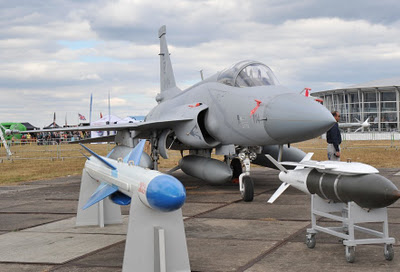
  The JF-17 was showcased at the defence exhibition with six air-to-air missiles incorporated in its wings.
  The JF-17 parked beside the Dassault Mirage 5 ROSE at the Pakistani Air Force base.

Saturday, January 21, 2012

JF-17 Thunder Fighter Jet To Get Block-2 Upgrades From 2012

he JF-17 Thunder fighter, co-developed by China’s Avic and the Pakistan Air Force (PAF), is to receive improvements that will start being produced with the Block-2 version from next year.

The enhancements will effect the data link and electronic warfare capabilities. An air-to-air re refueling capability will be added, as will be new guided weapons. A two-seat variant is being developed, too. The current program schedule calls for the Pakistan-based factory to deliver the JF-17 Block-2 to the PAF from mid-2012 to 2015. Then, a Block-3 version is planned from 2016. Block-1 aircraft are being delivered until the middle of next year.


PAF Air Chief Marshall Rao Qamar Suleiman said marketing efforts focus on those countries needing to replace old fighters such as the MiG-21, early Mirage, F-5 and Phantom types. The program’s target export countries can be found in Latin America, Africa and Asia. “We offer performance comparable to U.S. and European fighters when it comes to radar, dogfight missile, range and BVR [beyond visual range] capabilities, for one third of the cost,” Suleiman claimed.


So far, five countries are said to have taken a close look at the aircraft. China itself is currently evaluating the JF-17 and a decision is expected “shortly.” Avic and the PAF expect to sell “between 300 and 500 JF-17s” over the next 10 years.


The in-service fleet has logged a total of 10,000 flight hours with the PAF. In China, the JF-17 is also known as the FC-1 Xiaolong.


Wednesday, November 23, 2011

JF 17 crashes near Attock


A Pakistan Air Force (PAF) JF-17 Thunder multi-role combat aircraft on a routine training mission crashed near Mansar, Tehsil Hazro, Attock, on November 14, 2011. Unfortunately, aircraft's pilot Squadron Leader Muhammad Hussain lost his life in this accident as his parachute did not open after ejection from the aircraft.

Monday, November 21, 2011

Azerbaijan eyes Pakistan JF-17 Thunder aircraft

Azerbaijan is considering the purchase of the Pakistan Air Force (PAF) JF-17 Thunder combat aircraft, Pakistan Aeronautical Complex (PAC) officials have revealed.

The company held several rounds of discussions with Azerbaijan, but the talks have not yet reached the buy and sale stage.

The size of the initial order, however, has been determined and the exports to Azerbaijan will be realised in the near future, according to the Azeri-Press Agency.

The JF-17 Thunder is a lightweight, single-engine, multi-role combat aircraft jointly developed by China's Chengdu Aircraft Industries Corporation (CAC), the PAF and PAC.

The aircraft offers better manoeuvring capabilities than the Azerbaijan Air Force's MiG-29 fighter and will increase the air force's combativeness.

Meanwhile, PAC intends to develop a Block-2 version of the JF-17 with an advanced e-war system and additional weapons.

Wednesday, November 16, 2011

JF-17 Block III Multirole Fighter Confirmed induction in year 2016

 
JF-17 Block III was first confirmed by CAC official in dubai airshow 2011.
The Development work on Dual Seat version has already started and will be a Block-III production. Look for a significant change in engine and very advanced avionics in the Block-III.
 So far the existance of JF-17 Block III is confirmed and induction is supposed to be in 2016

As the block II is only 6 months far from reality..work on block III is scheduled to start Soon.

Wednesday, March 16, 2011

jf-17 fighter aircraft program in Grow

Pakistan’s Prime Minister, Yousaf Raza Gilani extended the government’s complete support of the JF-17 Thunder aircraft program. PM said this project has proven to be a great positive in the Pak-China relationship.

“This is the project that can become a true flagship of the historic cooperation and strengthen the relationship between our two countries”. These were the words of Gilani as he addressed a gathering of Chinese and Pakistani technicians during his visitation to the JF-17 manufacturing facility at the Pakistan Aeronautical Complex.
He also expressed his satisfaction and pride of the successful progress of the JF-17 program and the fact that it is constantly completing milestones. The JF-17 project is definitely one of the biggest joint project going on between Pakistan and its strategic partner – China. Both governments expect that such cooperation will strengthen their time-tested relationship. Gilani said that every Pakistani is cherishing the help which China provides to the JF-17 program and a couple of other project. PM believes this project will write another glorious chapter in the history of the cooperation between the two countries.
Gilani wasn’t the only official visiting the factory, other names there were General Khalid Shameem Wynne, Chairman Joint Chiefs of Staff Committee and Air Chief Marshal Rao Qamar Suleman, Chief of the Air Staff of the Pakistan Air Force were also visitors of the factory. They had the opportunity to witness the amazing progress which the JF=17 aircraft manufacturing program has achieved.
The JF-17 project is one of the most ambitious Pakistani programs and it has successfully complete many milestones. Thanks to this program, Pakistan can now proudly stand amongst the group of countries which manufacture modern combat aircraft.
The JF-17 is one of the most cost-effective, multi-role combat aircraft and it is specifically designed to meet the needs of the Pakistan Air Force.
The first batch is expected to be of 50 JF-17 Thunder aircraft which are to be equipped with the Chinese radar and SD-10 Beyond Visual Range Missile. Later batches are expected to be equipped with a more advanced radar.
The JF-17 military program is not the only program Pakistan-China cooperate on, other programs include F-22p Frigate and ZDK-03, which consists of Chinese AESA radar mounted on the Y-8F600 platform.

Friday, March 11, 2011

PAF to Roll Out 2nd Squadron of JF-17 Fighter Jets


No. 26 Squadron Black Spiders
ISLAMABAD: Pakistan Airforce enhancing its production capacity of JF-17 thunder fighter jets would roll out second squadron of the fighter jets

Pakistani JF-17 Thunder aircraft is an advanced multi-role light combat aircraft jointly developed by Chengdu and Pakistan Aeronautical Complex under a strategic collaboration project. The aircraft is designed to be cost-effective and can meet the tactical and strategic needs of the Pakistan Air Force, and various other air forces.
According to defense sources quoted by a private TV channel, the production capacity of these fighter jets would be enhanced by the PAF and 50 such fighter jets would be produced in Pakistan by the end of this year.
The sources also told that the JF-17 thunder fighter jets would replace the aging A-5 fighter jet bombers. Pakistan has invested US $600 million in this project to induct a new generation of multiple-role jet fighters in the PAF’s inventory.
I feel both the JF-17 and the LCA Tejas are comparable aircrafts.

Saturday, February 26, 2011

JF-17 a Sign of Pak-China Friendship...Now Using Pakistani Indigenous Computer Systems

Prime Minister Syed Yusuf Raza Gilani on Tuesday extended full support for the continuity of JF-17 Thunder aircraft programme, and said the project would prove as a flagship of Pak-China friendship.“This project can truly become as a flagship of our historic cooperation and strengthen our time-tested partnership,” the Prime Minister said while addressing a gathering of Pakistani and Chinese technicians during his visit to the JF-17 production facility at Pakistan Aeronautical Complex here. Gilani lauded the pace of JF-17 Thunder programme which had moved into a serial production stage in a record time.

He also acknowledged the role of Chinese experts for imparting technical know-how to the Pakistani technicians for the transfer of technology.

“The support provided by our Chinese friends in this, and in so many other common projects between Pakistan and China is greatly cherished by every Pakistani,” he said.


The Prime Minister termed the project a reflection of deeper bond between the two governments and the people.
“The success of the project would add another glorious chapter in our long history of cooperation,” he said.
Gilani went around different sections of the facility and expressed satisfaction that the project milestones were being accomplished in an efficient and timely manner.

He said Pakistan Airforce with a initiative like JF-17 program was not only rendering valuable services for strengthening the national defence but also providing a valuable opportunity to the youth.
“It is an opportunity involving a more constructive and positive approach to life that offers education, livelihood and training and leading to a better life,” he said.
Gilani exhorted all the personnel associated with the project to commit all “faculties of body and soul” for its success.
He expressed hope that with Allah’s blessing and commitment, many more laurels shall come in shape of timely completion of projects.
Chief of Air Staff Air Chief Marshal Rao Suleman Qamar said with the support of the government, twenty two JF-17 aircrafts had been inducted into the 26th squadron of the PAF, while eight others were in various stages of tests and trials. He said the aircraft, whose production began on 13 June 2009 and the first made-in-Pakistan rolled out on 23rd Nov 2009, has successfully made its presence felt at the air shows at Farnborough, UK and Zhuhai, China. He said the aircraft also participated in the Highmark and the Azm-e-nau exercises.
He said a number of air forces around the world were eyeing the new entrant into the arena with keen interest.


The Air Chief presented to the Prime Minister a gift of a statue of an Air Force pilot - a symbol of determination to succeed despite all odds. Earlier the Prime Minister was apprised that Pakistan Aeronautical Complex (PAC) Kamra was now providing three major computer systems for the JF-17 aircraft.

These include Weapon Mission Management Computer, Electro-Mechanical Management Computer and Light Warning Computer.
The PAC was currently producing three aircraft a month and with a larger facility will be able to increase production and enable Pakistan earn a handsome foreign exchange.
Chairman Joint Chiefs of Staff Committee Khalid Shamim Wyne, Defence Minister Chaudhry Ahmed Mukhtar, Health Minister Makhdoom Shahabuddin and Finance Minister Abdul Hafeez Sheikh also accompanied the Prime Minister.

Saturday, February 12, 2011

JF-17 Program Continues to Grow


Pakistan’s Prime Minister, Yousaf Raza Gilani extended the government’s complete support of the JF-17 Thunder aircraft program. PM said this project has proven to be a great positive in the Pak-China relationship.“This is the project that can become a true flagship of the historic cooperation and strengthen the relationship between our two countries”. These were the words of Gilani as he addressed a gathering of Chinese and Pakistani technicians during his visitation to the JF-17 manufacturing facility at the Pakistan Aeronautical Complex.


 He also expressed his satisfaction and pride of the successful progress of the JF-17 program and the fact that it is constantly completing milestones. The JF-17 project is definitely one of the biggest joint project going on between Pakistan and its strategic partner – China. Both governments expect that such cooperation will strengthen their time-tested relationship. Gilani said that every Pakistani is cherishing the help which China provides to the JF-17 program and a couple of other project. PM believes this project will write another glorious chapter in the history of the cooperation between the two countries.

Gilani wasn’t the only official visiting the factory, other names there were General Khalid Shameem Wynne, Chairman Joint Chiefs of Staff Committee and Air Chief Marshal Rao Qamar Suleman, Chief of the Air Staff of the Pakistan Air Force were also visitors of the factory. They had the opportunity to witness the amazing progress which the JF=17 aircraft manufacturing program has achieved.

The JF-17 project is one of the most ambitious Pakistani programs and it has successfully complete many milestones. Thanks to this program, Pakistan can now proudly stand amongst the group of countries which manufacture modern combat aircraft.


Monday, July 5, 2010

JF 17 - Pakistan's Pride

A new aircraft programme for Pakistan has brought benefits not only to the air force but to its aerospace industry. Air Commodore Azfar A Khan (retd) describes how and why the aircraft that marks a milestone in the aviation history of Pakistan was developed.

When the time came to replace its large, obsolete fleet with modern, lightweight, multi-role combat aircraft, the Pakistan Air Force (PAF) opted for a low-cost solution and not pricier Western designs. The result was an aircraft that could be manufactured in Pakistan in collaboration with the People's Republic of China - the lightweight fighter bomber JF-17 Thunder.
Developed by the Pakistan Aeronautical Complex and Chengdu Aircraft Industry, China, production is being undertaken at Pakistan Aeronautical Complex, Kamra.
The PAF officially inducted its first JF-17 squadron on 18 February this year. Initially, about 10 to12 squadrons are to be produced, but the PAF will ultimately acquire up to 250 pieces. From 2011, 15-16 aircraft will be produced annually, which may eventually be increased to 25 per year.
It is hoped the JF-17 will provide a low-cost replacement for a number of developing countries currently operating ageing MiG-21/F-7 and F-5 aircraft, such as Azerbaijan, Algeria, Sudan, Zimbabwe, Bangladesh, Egypt, Iran, Lebanon, Malaysia, Morocco, Myanmar, Sri Lanka and Nigeria. Some of these nations have already confirmed orders.
Specification
The JF-17 is powered by a single Russian RD-93 turbofan engine, a widely used model known to be reliable. The turbofan design gives more thrust and significantly lower specific fuel consumption than a turbojet engine. The engine has gained attention for its acceleration and quick response, with test pilots describing reactions as "virtually instantaneous". Using a single engine also significantly reduces both maintenance time and cost.
"Initially, about 10 to12 squadrons are to be produced, but the PAF will ultimately acquire up to 250 pieces."
The aircraft can be armed with up to 3,629kg (8,000lb) of air-to-air and air-to-ground ordnance along with other equipment mounted externally on the aircraft. The glass cockpit, meanwhile, incorporates an electronic flight instrument system (EFIS) and a wide-angle head-up display (HUD), and it has a minimum total field of view of 25 degrees. The EFIS provides basic flight information, as well as tactical, engine, fuel, electrical, hydraulics, flight control and environment control systems information. The HUD and multi-function display (MFD) are 'smart' (meaning they can be configured by the pilot to show any of the available information), the avionics system is all-digital and fully integrated, and the solid state avionics is of a modular design.
Several radars were tested onboard prototypes of the JF-17, including Israel's Elta EL/M-2032, Russia's Phazotron Super Komar, Italy's FIAR Grifo-S7, Brittain's GEC-Marconi Blue Hawk and France's Thomson-CSF RC-400. However, a Chinese radar was selected for the first batch of craft, although Italy and France are in the running for future contracts, according to reports.
The software written for the avionics comprises more than one million lines of instructions, making use of the concept of open architecture. This software is written using the popular civilian C++ programming language, rather than a military language such as Ada, to better utilise the large number of civilian software programmers available in the market.
Building
The production of JF-17 parts and components begun as far back as 2005 and manufacture of its sub-assemblies started in 2008. The production of major assemblies is undertaken by Pakistan's large public sector units (PSUs), while parts and components are provided by private-sector suppliers.
Pakistan has a highly skilled and trained technical workforce - a prerequisite for the manufacture of an indigenous aircraft - that can be cheaper to employ when compared with other areas around the world. For example, some of the workforce deployed for the production of the JF-17 are retired personnel from the Pakistan Air Force. This manpower is available at a rate of $10 per hour whereas the international market can charge up to $45 per hour.
"The total cost of the JF-17 programme is US$500m."
It is this cost-effectiveness that led the PAF to take on the task of making its own aircraft. The unit production cost of a JF-17 translates into approximately US$15 million apiece whereas a multi-role aircraft in the international market is available for US$50m a piece. Overall, the total cost of the JF-17 programme is US$500m, divided equally between China and Pakistan.
Furthermore, Pakistan will earn a good exchange rate through the sale of this aircraft and its associated spares to other countries, keep its retired aircraft workers employed, and provide the country's internal market with new opportunities to build technologies and develop new innovations.
  Main A JF-17 on display at the IDEAS 2008 defence exhibition in Karachi, Pakistan.

linkwithin

Related Posts Plugin for WordPress, Blogger...
© Copyright 2012-2013 — Asian Defence News. All Rights Reserved